
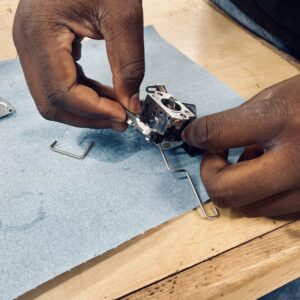
According to Abe Hepler, Pierceton Woods Academy Vice President of Residential Services, that practical focus is intentional.
“We provide our students with opportunities that set them up for success, while also pushing them to learn new skills they can be proud of,” says Hepler. “An added benefit is that they can begin exploring career paths that they might enjoy when they transition from our program to a full-time job.”
For a lot of young people, the hardest part of getting back on track is believing they still have something meaningful to offer. School can help. Counseling can help. Structure definitely helps. But there’s also something quietly transformative about learning how to build, repair, cook, weld, or create something with your own hands.
Pierceton Woods Academy is capitalizing on this reality in ways that are transforming the lives of the young men it serves.
The vocational program at Pierceton Woods gives students practical job skills alongside personal growth and education. It’s not built around abstract theory alone. Students participate in hands-on training opportunities that introduce them to real trades, responsibilities, and workplace expectations—the kinds of experiences that make adulthood feel a little less intimidating and make ambitious goals feel within reach.
The academy offers vocational pathways that help students explore future careers while also developing discipline, accountability, and confidence. Students gain exposure to areas like woodworking, automotive work, culinary arts, and other skilled trades that can lead directly to employment opportunities after graduation.
According to Abe Hepler, Pierceton Woods Academy Vice President of Residential Services, that practical focus is intentional.
“We provide our students with opportunities that set them up for success, while also pushing them to learn new skills they can be proud of,” says Hepler. “An added benefit is that they can begin exploring career paths that they might enjoy when they transition from our program to a full-time job.”
For many students, vocational education creates a different kind of momentum than traditional classroom learning alone. Progress becomes visible. Skills improve through repetition. Confidence grows because effort produces something concrete. It’s hard to fake your way through welding or repairing equipment. Either the work holds up or it doesn’t.
Pierceton Woods Academy also emphasizes responsibility within the work environment itself. Students learn the value of punctuality, teamwork, communication, and consistency –skills employers notice immediately and that schools sometimes struggle to teach through lectures alone.
“Those so-called soft skills are some of the biggest differentiators in today’s work environment,” says Hepler. “We believe our students will be well prepared for any career they pursue by focusing on habits that all employers value.”
The larger goal is not simply career readiness, however. It’s helping students imagine a future where they can contribute meaningfully to a workplace, support themselves, and take pride in what they do. For students who may have experienced setbacks and instability earlier in life, that shift can be incredibly powerful.
And the truth is, purpose often arrives quietly.
Sometimes it shows up in a student realizing they’re good with tools. Or discovering they enjoy solving mechanical problems. Or as organization’s Facilities and Vocational Director Bob Jones explains, it can be as simple hearing someone say, maybe for the first time, “You did a great job.”
“Many of us received positive feedback when we were kids, but that’s not always true of our students,” Jones says. “Our program is often the first building block toward establishing their self-worth.”
In a culture that often pushes everyone toward the same narrow definition of success, Pierceton Woods Academy offers another path–one built around craftsmanship, persistence, and real-world preparation. Not every student needs the exact same roadmap. Some just need the chance to discover that they can build a life with their own two hands and solve problems not everyone can solve. While self-discovery is often the greatest challenge they’ll take on, the byproduct of discovering new vocational skills is a tremendous benefit.