
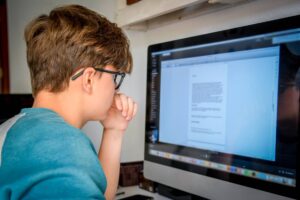
At Pierceton Woods, education runs alongside recovery through an on-campus, year-round school. With self-paced online coursework, blended instruction, and electives like art and PE taught by licensed teachers, students get an educational approach that fits their academic needs and treatment plan.
Most school calendars assume a straight line: start in August, move with the class, hit graduation on schedule. The young men who come to Pierceton Woods Academy usually haven’t been on that line for a while.
Trauma, behavioral struggles, substance abuse, an unstable home can pull kids out of the normal academic rhythm long before anyone decides to intervene. Some are behind on credits. Some just never had a classroom that worked for how they learn or what they were dealing with at the time.
At Pierceton Woods, education isn’t separate from the recovery work—it runs alongside it. The facility offers an on-campus, year-round school built so students can keep moving academically even while they’re sorting through everything else. Instead of forcing kids into one pace or one format, the program flexes: self-paced online coursework, blended instruction, and electives like art and PE taught by licensed teachers. Students end up with a mix that fits both where they are academically and what their treatment plan needs.
And it’s working. In 2024, 86 percent of students at Pierceton Woods made measurable progress toward their academic goals.
The self-paced setup matters more than it might sound like on paper. A student can start in October or February and not feel like he’s already lost the year. Students work toward either a high school diploma or a GED, moving at a pace that builds confidence instead of inviting comparison to everyone else in the room.
And the work doesn’t disappear once they leave campus. The school has earned accreditation from Cognia, a globally recognized nonprofit that works with more than 40,000 schools and systems in over 100 countries, evaluating them on teaching quality, leadership, and overall effectiveness. Practically, that means credits earned at Pierceton Woods transfer into Indiana public schools and other accredited high schools. Students don’t lose ground just because they are on a different path.
There’s something underneath the credits, though. Every finished assignment is a small proof that a student can succeed—that he can learn, finish something, pass a class. And that leads to him starting to believe something bigger: that what comes next doesn’t have to look like what came before.
At Pierceton Woods, that’s the whole approach—progress, one class and one credit at a time, until it adds up to something a young man didn’t think he’d get back to: a sense of normalcy and a feeling of pride.